

This video will guide you through the necessary steps to modify your files and simultaneously maintain both versions of the database until you are satisfied the new version is accurate.
Category: Favorites
Data Scientist
A data scientist is a professional who applies scientific methods, statistical algorithms, and machine learning techniques to extract insights and knowledge from structured and unstructured data. In simpler terms, data scientists analyze and interpret complex data sets to uncover patterns, trends, and insights that can be used to inform business decisions, product development, and other applications.
Data scientists are skilled in data manipulation and have a deep understanding of programming languages, statistical modeling, and data visualization tools. They work with large amounts of data from various sources, including databases, social media platforms, and sensor networks, to extract meaningful insights.
Data scientists are essential in today’s data-driven world, where businesses and organizations require accurate insights to make informed decisions. They can work in various industries, including finance, healthcare, e-commerce, and marketing, among others.
To become a data scientist, one typically needs a strong foundation in mathematics, statistics, and computer science, along with experience in programming languages such as Python or R. Additionally, data scientists must possess critical thinking skills, attention to detail, and the ability to communicate complex data analysis in a clear and concise manner.
In summary, data scientists are highly skilled professionals who play a crucial role in interpreting and analyzing complex data sets to inform business decisions and drive innovation.
Application & Database Modernization IBM i
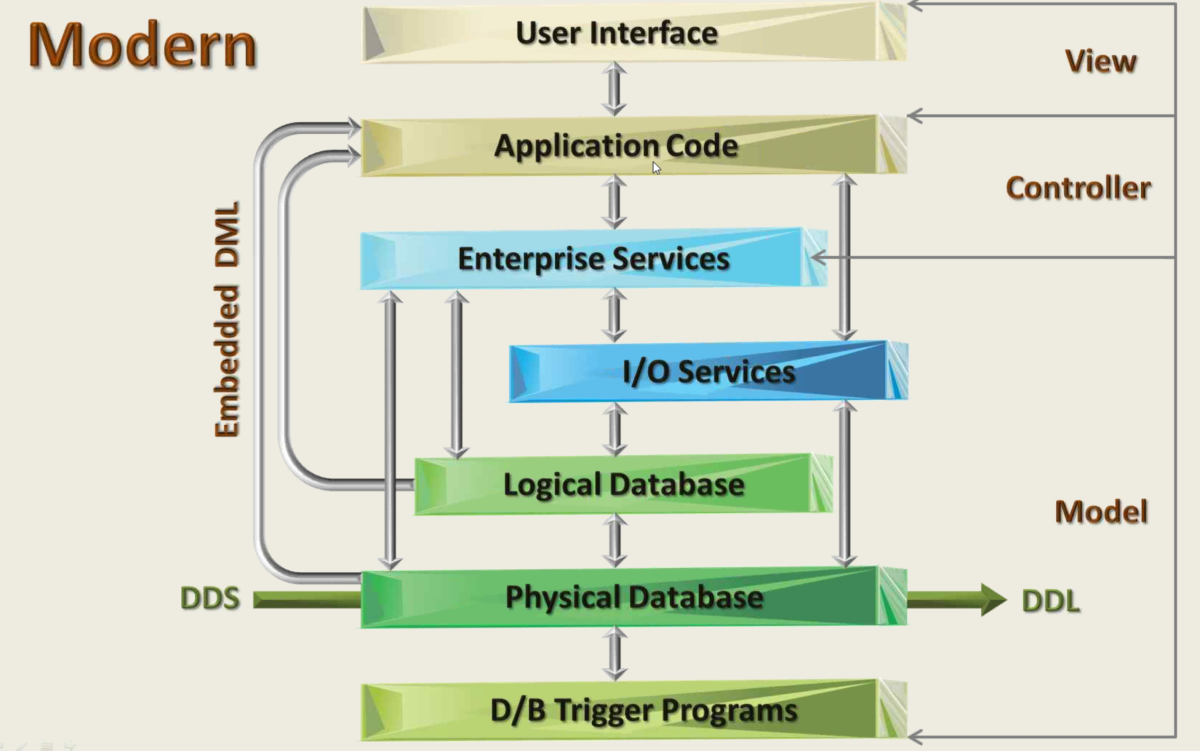
In today’s fast-paced world, businesses are constantly looking for ways to streamline their operations and increase efficiency. One area that has seen significant advancement in recent years is database modernization. This innovative approach to software development is designed to help organizations bring their systems up to date and compete.
What is Application & Database Modernization?
Database modernization implies updating an organization’s existing software systems to take advantage of data-centric technologies. This involves a combination of code and database refactoring, to create a more efficient and competitive software infrastructure that is better suited to meet the changing needs of businesses.
Benefits of Database Modernization
There are many benefits to modernizing an organization’s code database. Some of the most important include:
- Increased efficiency: By taking advantage of the functionality built. into DB2 (trigger programs & constraints).
- Degrease maintenance & testing effort: No need to check the constraints the old fashion way when the operating system does it for you and secondly when the business logic is consolidated in the database with trigger programs there is no need to repeat it every time you write a new program. This will result in less coding and less testing over time.
- Increased competitiveness: By adopting modern software development practices, organizations can stay ahead of the curve and remain competitive in their respective industries.
- Better security: With updated software systems, organizations can take advantage of the latest security features and technologies, reducing the risk of data breaches and other security-related issues.
- Performance: Because triggers and constraints run in the operating systems storage pool they are faster
The Process of Application & Database Modernization
The process of application & database modernization involves several key steps:
Assessment: The first step in the code database modernization process is to assess the existing systems to determine what needs to be updated and how.
Code refactoring: Once the systems have been assessed, the next step is to refactor the existing code to make it more efficient.
Database migration: This step involves migrating the existing database to a modern platform, such as a cloud-based solution.
Testing: Once the code has been refactored and the database migrated, the final step is to test the updated systems to ensure that they are working correctly.
The Future of Database Modernization
As technology continues to evolve, database modernization will become increasingly important for organizations of all sizes. By staying ahead of the curve and adopting modern software development practices, organizations can remain competitive and achieve their goals more effectively.
Conclusion
Code database modernization is a critical component of any software development strategy. By updating existing systems to take advantage of modern technologies, organizations can improve efficiency and become more competitive and improve security. With the right approach and tools, the future of code database modernization on the IBM i is bright and full of opportunities.
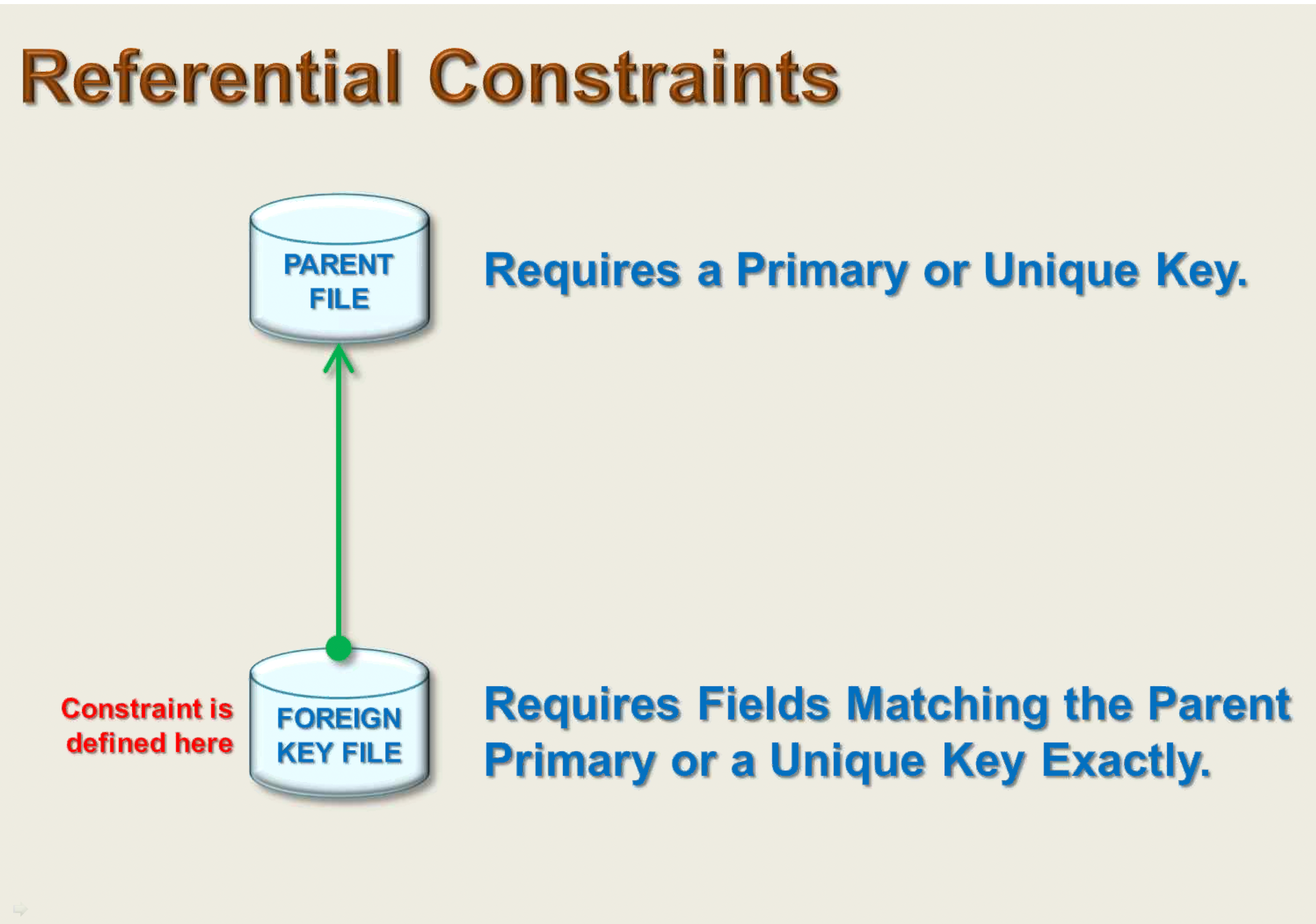
Referential Constraints IBM i
Benifits of using Referential Constraints IBM i
Accuracy – prevent orphaned records by letting the RDBMS validate the parent/child relationships between tables
Performance – RDBMS runs in the operating system storage pool and provides excellent performance
Functionality- The functionality provided by the constraints is all functionality that need not be performed in the programs, resulting in less coding and testing
DB2 Relational Database Components IBM i
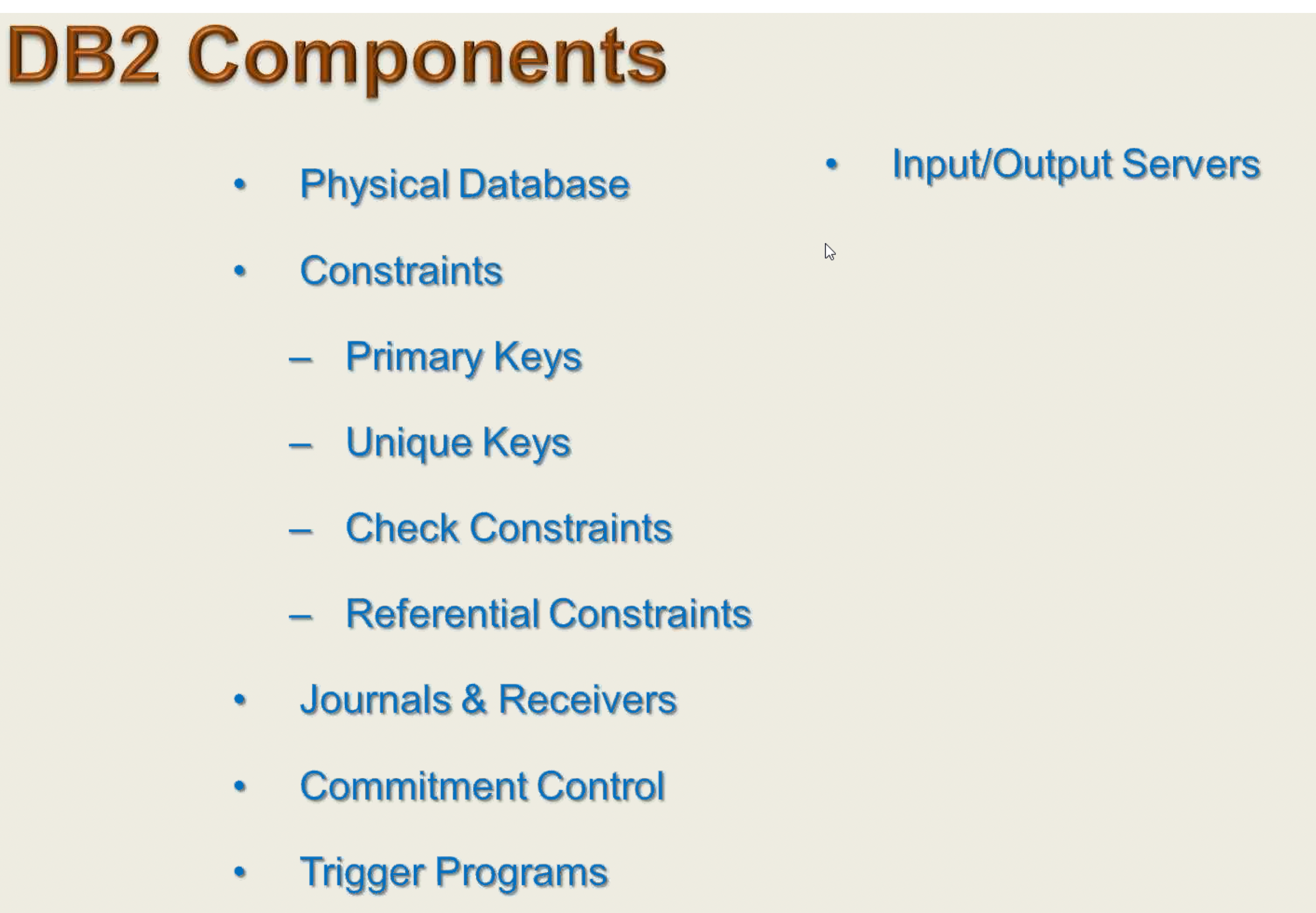
Overview of the Components that makeup DB2 on the IBM i
DB2 comes with some very powerful features
Performance – RDBMS (Relational Database Management System) runs in the operating system storage pool. Therefore constraints and trigger programs become prioritized
Reduce Coding effort – RDBMS will enforce constraints negating the need to do so in the programs That mean’s not having to declare various master files in the programs used to verify data. That has a trickle-down effect on testing and maintenance.
Trigger Programs. Consolidate all the validation rules in one place. Do it once in a file trigger and you no longer have to do it in multiple programs. Once again there is a trickle-down effect on testing and maintenance.
I/O servers while not strictly part of RDBMS, complement the Relational Database by establishing a border between the application and the database
I/O Servers IBM i
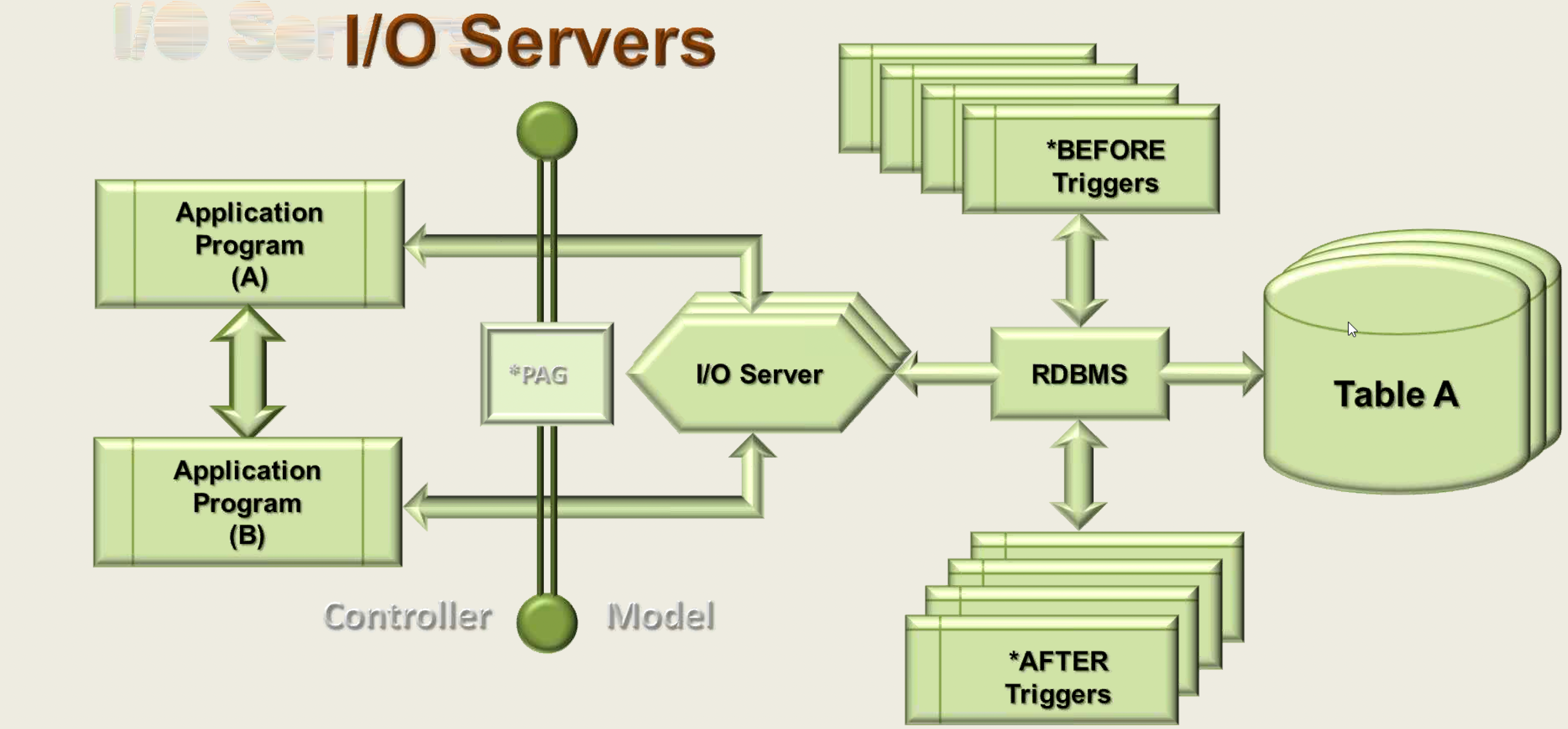
I/O Servers Provide
Border Patrol – Separates the Database from the program.
Performance – Consolidates open data paths which reduces the size of the PAG and the program
Security – By defining the table as 1. public exclude 2 owned by a profile (with no sign-on capabilities) you are providing a high level of security. The only access is threw the I/O server.
The compelling reason for using an I/O server is to manage data definition changes as in expanding fields or getting the data type right.